Put behavior and deployment on separate axes
A hosted chatbot runs on infrastructure operated by a service or its providers. A local model runs on infrastructure you operate. Either setup can have instructions, usage constraints or safety mechanisms.
Available model weights are another question: can you obtain the files required to run that particular model, and what does its license permit? Local execution and licensing should be checked separately. A convenient download does not tell you every permitted use.
Likewise, a product calling itself uncensored has not explained its hardware requirements, data handling or reliability. Start with the task you need to perform.
Compare responsibilities before comparing slogans
| Question | Hosted workspace | Local setup |
|---|---|---|
| Who maintains the runtime? | The service operates it. | You maintain your chosen software and machine. |
| Where do inputs go? | Check the service’s provider and data policies. | Check whether every component stays local. |
| What limits the workload? | The plan and service configuration. | Hardware capacity and your configuration. |
| Who handles storage? | The workspace’s storage controls. | Your files, logs and backups. |
This is an architecture comparison, not a benchmark. It does not claim that one setup produces better answers or that local execution automatically removes restrictions.
Follow the complete data path
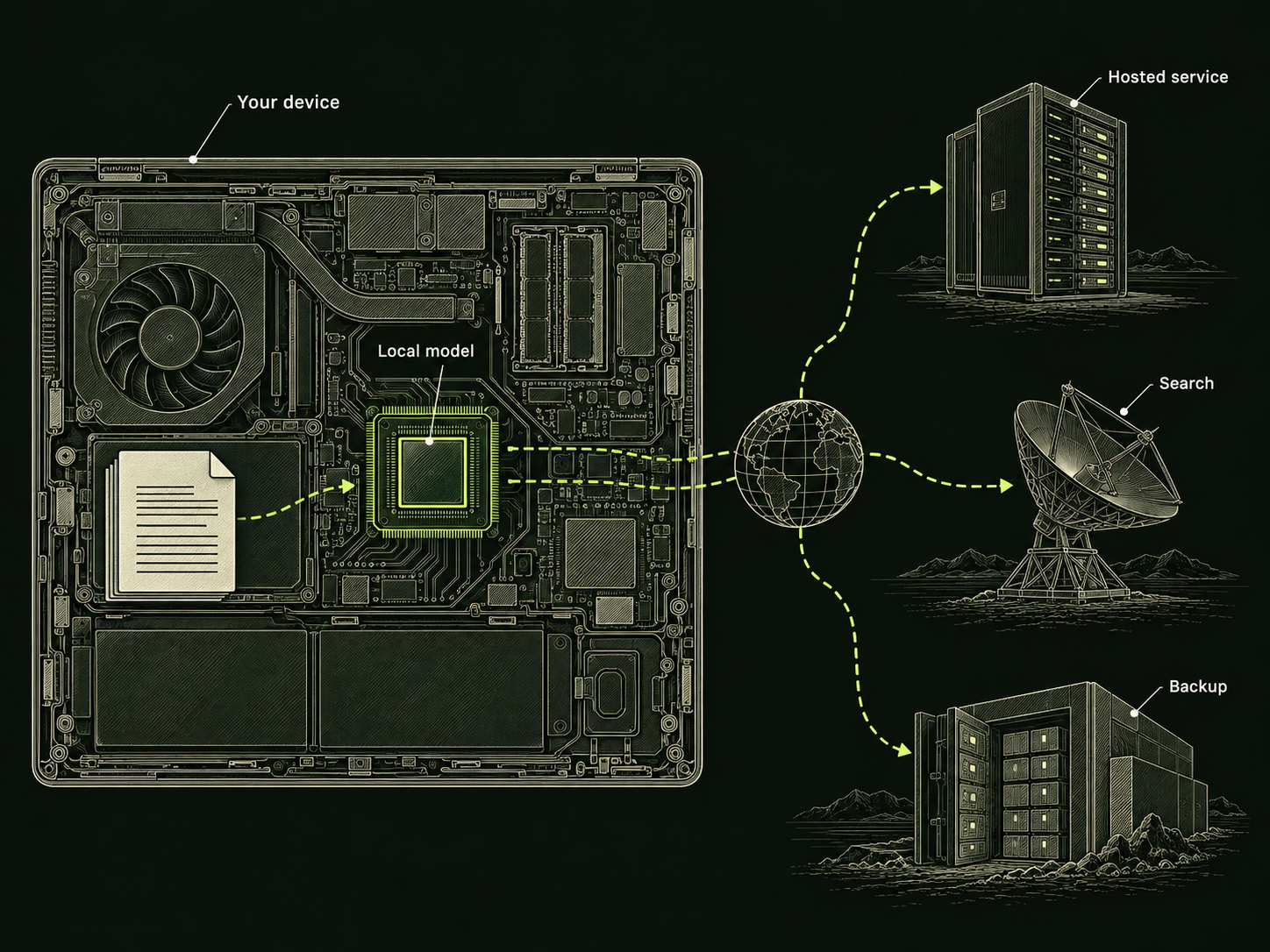
Consider an assistant running a local model while a search tool contacts an external service. The model’s inference can be local while the overall task still sends information elsewhere. Look at tools, telemetry settings, extensions and backup destinations as well as the model.
Ollama’s FAQ describes local operation and separately discusses cloud features and ways to disable them. Use the documentation for your installed version and chosen configuration instead of assuming that every feature has the same data path.
Further reading: Ollama’s FAQ.
For a sensitive draft, write down the route: input file, application, model, optional tools, output storage. This small inventory makes the word “private” easier to assess.
A local setup still has a budget
Local inference uses computing resources. Relevant costs may include hardware, electricity, storage and the time spent resolving software problems. Hosted access has its own plan limits and payment structure.
Before choosing, try a representative task on the hardware you already have. Record completion time, whether the model fits in memory and whether the output meets your requirements. Do not substitute a leaderboard score from a different configuration for that check.
A writer revising short scenes and a developer analyzing large files may need different setups. Define the workload before shopping for a model.
Make the choice concrete
- List three tasks you expect to repeat.
- Identify information that must not leave your environment.
- Decide who will maintain the software and backups.
- Check the chosen model’s license and actual runtime requirements.
- Evaluate output quality on your own representative inputs.
DarkGPT is a hosted workspace, not a local model runner. Its Pricing page describes memberships, and its Privacy policy describes data handling. Choose it for the workflow it provides, rather than assuming the name promises a different architecture.
Sources & further reading
Follow the original source to check its date and scope.
Make it your next question
Try this prompt
Use this promptHelp me compare a hosted AI workspace with a locally run model. First ask about my hardware, data sensitivity, tasks and maintenance skills. Separate verified facts from assumptions.
Opens chat with this prompt filled in. You choose when to send it.