Chatbot, workflow and agent describe different control
A chatbot primarily interacts through messages. Some chatbots can also use tools, so the name alone does not tell you how much they can do. Inspect whether the system can only suggest an action or can actually perform it.
A fixed workflow follows a path chosen in application code. It may use a model at one step to classify a message or draft a response. An agentic system gives the model more responsibility for choosing steps and tools based on the task and intermediate results.
Anthropic’s engineering guidance distinguishes predefined workflows from agents that dynamically direct tool use. That architectural distinction is more useful than a marketing label. Ask where the decisions live and how their consequences are checked.
One support task can produce three different designs
Imagine a fictional online store receiving a customer’s question about a delayed package. A basic assistant can explain a supplied shipping policy and help draft a response. The human still retrieves the order record and sends the message.
A fixed workflow can receive a validated order reference, retrieve the permitted tracking record and return the matching status. The steps are known. A model might make the explanation more readable without deciding which systems to explore.
An agent might investigate an ambiguous delay by choosing among permitted tracking and support tools, comparing results and preparing a proposed resolution. That flexibility can be useful when the path is not known in advance. It also creates more ways to make a wrong action, so the design needs a clear boundary and a visible handoff.
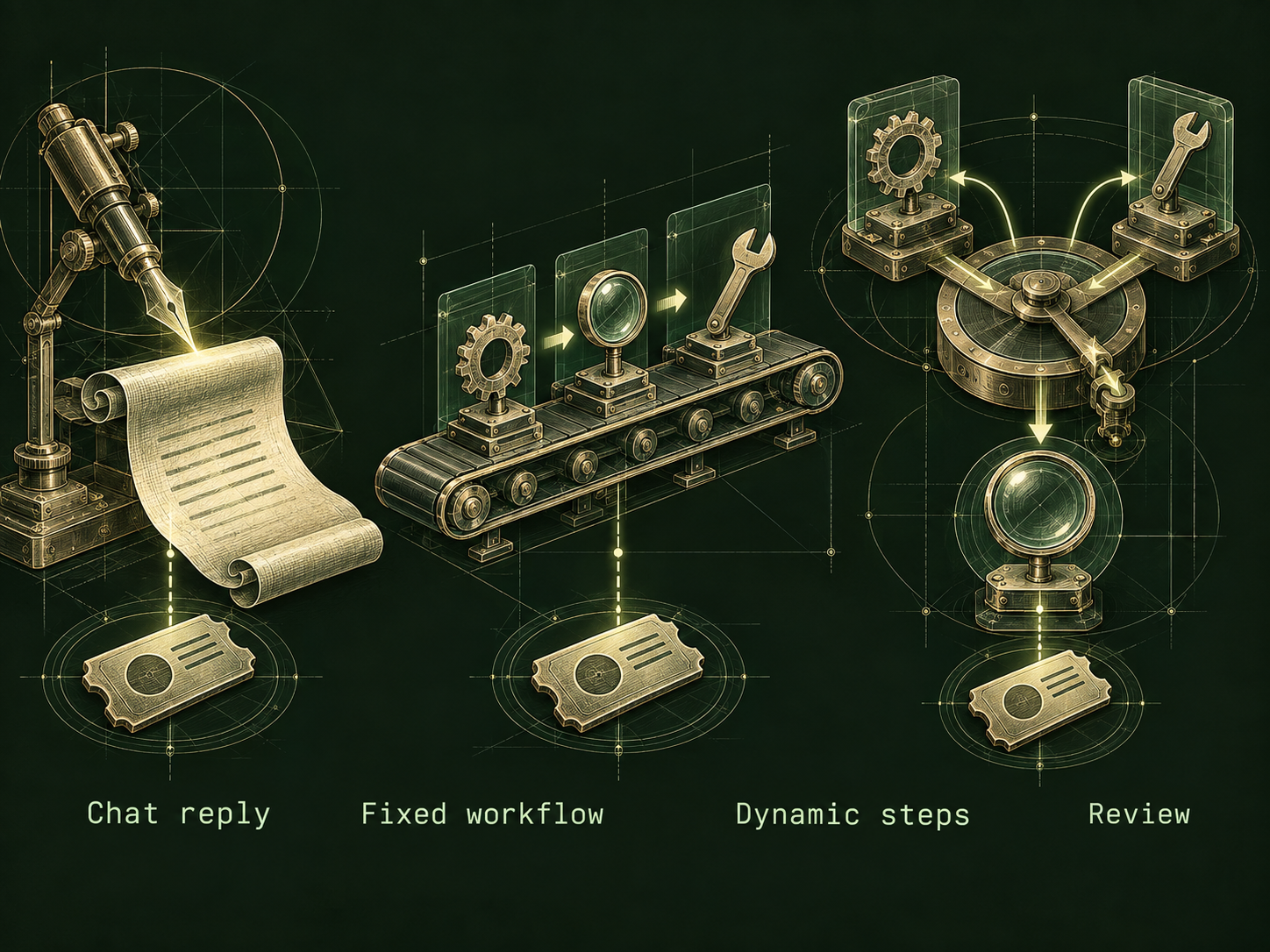
Choose the simplest design that handles the uncertainty
| Situation | Useful starting design | Reason |
|---|---|---|
| The user needs an explanation | Chat with supplied evidence. | No external action is necessary. |
| The steps are stable and known | Fixed workflow. | The application can control the sequence directly. |
| The next step depends on findings | Bounded agent with appropriate tools. | Flexible investigation may be valuable. |
| The result requires accountable judgment | Human decision with assisted preparation. | A generated plan does not assign responsibility. |
Do not add autonomy to a straightforward task just because the model can describe a plan. A predictable status lookup may be easier to inspect and maintain as a fixed workflow.
For an uncertain investigation, specify why dynamic tool choice is needed. If you cannot name that uncertainty, the extra complexity may not address a real problem. The architecture should follow the task rather than the other way around.
Separate proposing a resolution from executing it
For the support example, collecting evidence and drafting a reply are different from issuing a refund or changing an address. Assign those operations explicitly. The agent should not infer permission to perform every step merely because it has been asked to help the customer.
Define when it must hand off: conflicting records, an unclear order match, a request outside policy or an action requiring approval. Return the supporting evidence and the unresolved question so the reviewer can make a useful decision.
The controls belong in the application around the model. Our permissions guide covers scoped tools and enforced limits in detail. Here the design choice comes first: decide which kind of system is necessary before connecting the tools.
Judge completion rather than the length of the plan
A long plan does not establish that anything happened. Review the record of retrieved evidence and completed actions. Did the workflow identify the right order? Was the draft consistent with the actual tracking result? Did the system stop at the agreed boundary?
Test a straightforward case, a missing record and a conflicting record. Decide the expected result before the trial. An agent that keeps searching indefinitely has not necessarily made more progress than a fixed workflow that returns a precise unresolved question.
Include execution time, cost and review effort when choosing the design. Flexibility has value when it resolves useful uncertainty. A successful system finishes the permitted task with an outcome someone can inspect, rather than merely producing a convincing description of autonomous work.
Sources & further reading
Follow the original source to check its date and scope.
- Building effective agents
Anthropic | architectural distinction between predefined workflows and dynamic tool use; start with the simplest useful design.
Make it your next question
Try this prompt
Use this promptHelp me decide whether an invented support workflow needs a chatbot, fixed automation or an agent. Identify where the next step is already known and where judgment is required. Define success and a human handoff before suggesting tools.
Opens chat with this prompt filled in. You choose when to send it.