What an AI hallucination is
An AI hallucination is generated content that is false, fabricated or inconsistent with the relevant evidence or input. NIST uses the term confabulation for confidently presented erroneous content. The term describes an output problem; it does not establish that the model consciously chose to deceive.
Language models produce responses using learned patterns and the context available to them. A response can be linguistically convincing without being tied to a verified fact. Tools and retrieved evidence can help, but their presence does not automatically validate the interpretation.
Watch for precise details that arrived without a clear source: dates, quotations, publication titles and product limits. Precision makes a sentence easy to trust, but it can also make a fabricated detail look unusually authoritative. Ask what supports the detail rather than how confidently it was written.
Not every wrong answer has the same cause
| Pattern | What it looks like | What to check |
|---|---|---|
| Fabrication | A quotation or reference that cannot be found. | The original publication or record. |
| Misattribution | A real source is attached to the wrong claim. | The passage and its actual conclusion. |
| Outdated fact | An old rule is presented as current. | Effective date and later changes. |
| Unsupported inference | The answer fills a gap as if it were known. | Which premise was supplied and which was assumed. |
| Calculation error | A plausible explanation contains a wrong total. | A reproducible calculation with stated units. |
The checks differ because the failures differ. Search can help find a publication, but a calculator is a better way to verify a total. A newer source may repair an outdated rule while doing nothing for a mistaken interpretation.
This table is a review framework. It does not claim that these errors occur at the same rate in every model or that a single prompting technique eliminates them.
The forecast that quietly turns assumptions into facts
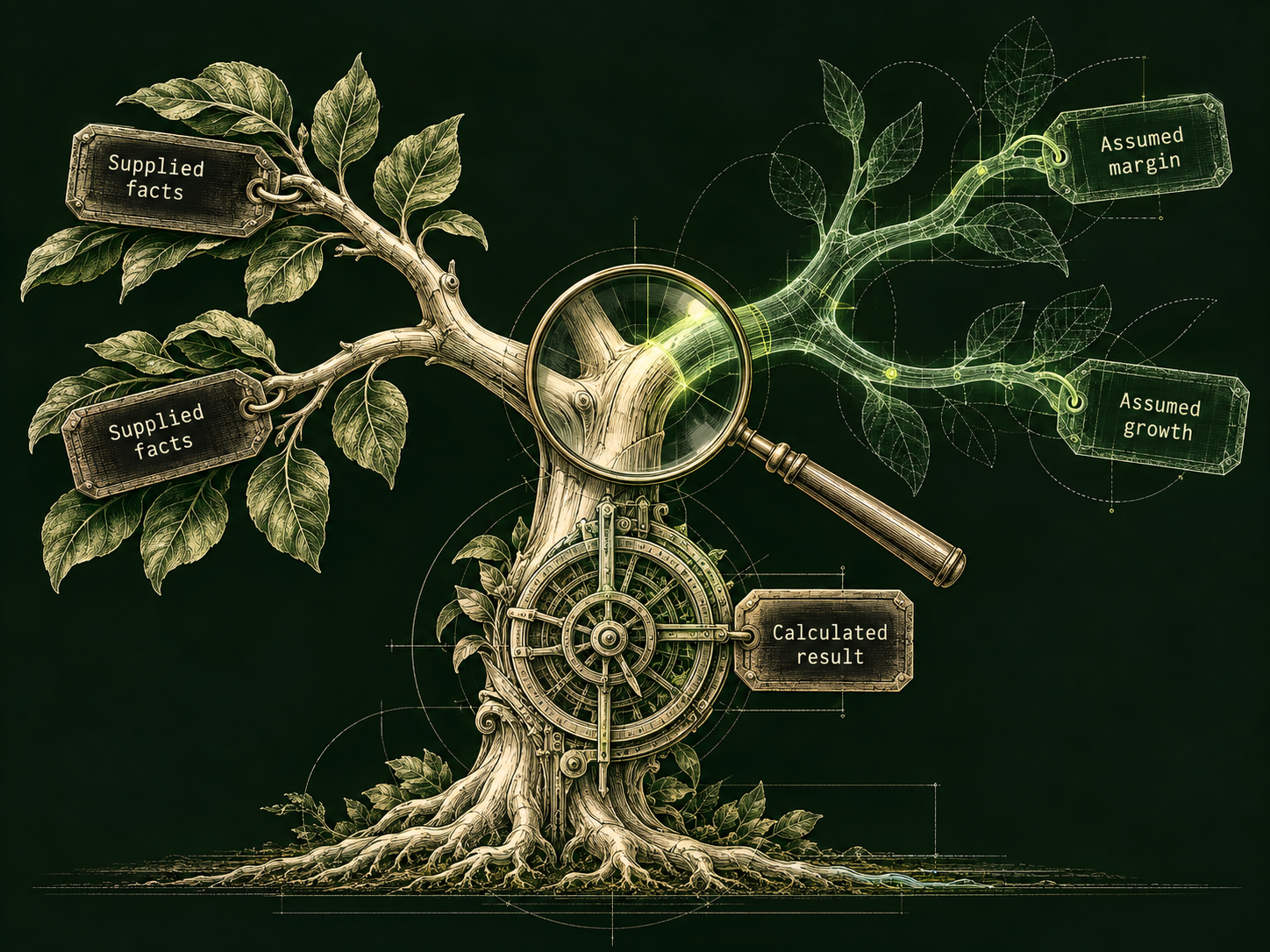
Consider an invented shop with 240 weekly orders and an average order value of $18. Those supplied figures imply $4,320 in weekly revenue. They do not specify profit, monthly revenue or future growth.
An assistant might expand the brief into a forecast by assuming four weeks per month, a 30% margin and 10% growth. The arithmetic could be internally consistent while the forecast remains unsupported. The error is treating new assumptions as facts about the shop.
Mark each output line as supplied, calculated or assumed. “240 × $18 = $4,320” is reproducible from the input. “Profit is $1,296” depends on a margin you never provided. “Revenue will rise next month” needs evidence beyond those two input numbers.
Keep the assumptions visible if you want a scenario. A hypothetical margin can be useful for planning when it is labeled. It becomes misleading when the label disappears and the scenario is presented as an observed business result.
Verify the claim with a method that can settle it
For a quotation, find the original text. For a source, confirm that the publication exists and read the passage supporting the claim. For a calculation, reproduce it independently. For a changing policy, check the current authoritative document and its effective date.
Ask the assistant to identify uncertain parts and missing inputs, but treat that as assistance with the review. A model’s own confidence estimate is not an independent verification. Asking the same system “are you sure?” may produce reassurance instead of new evidence.
Keep an evidence note beside claims that affect your decision. Include the source, date, relevant passage and remaining uncertainty. A bare list of links is insufficient if you cannot explain which link supports which statement. The aim is a result another person can follow without trusting the chatbot’s voice.
Reduce opportunities for invented detail
Supply the actual reference material when the task depends on it. Request a distinction between facts in that material and the assistant’s interpretation. Make it acceptable to return “not established by the supplied evidence” rather than complete every field.
Break a large task into evidence gathering, synthesis and verification. Preserve the original sources between stages so a polished summary does not become the only record. Review the most consequential claims first rather than spending equal effort on every sentence.
No wording guarantees a hallucination-free response. Good workflow design makes unsupported content easier to detect before it travels into a report or decision. The useful question is not whether the answer sounds cautious. It is whether the important claims can survive the appropriate checks.
Sources & further reading
Follow the original source to check its date and scope.
- Generative AI Profile | confabulation
NIST | confidently erroneous output and the importance of source verification.
Make it your next question
Try this prompt
Use this promptReview an answer I provide for claims that need verification. Separate supplied facts from inferences and unsupported details. Identify the original evidence needed for each important claim. Do not invent citations or confidence percentages.
Opens chat with this prompt filled in. You choose when to send it.