Choose the skill behind the homework question
Before asking for help, write the action you need to learn. “I need to understand percentages” is broad. “I need to recover the original price after a discount” identifies a particular relationship you can practise.
Follow the rules for your course or assignment. If AI assistance is restricted, work within those restrictions. Do not present a generated solution as your own independent work. For permitted practice, show the assistant your attempt so it can respond to the step you actually took.
Decide what success will look like without the assistant. It might be solving a new problem, explaining why a denominator is used or identifying a mistake in a worked example. That goal makes the session more useful than asking whether the final answer “looks right.”
A discount problem with a tempting wrong step
In this invented practice problem, a jacket costs 72 after a 20% discount. What was the original price? A common-looking attempt is to add 20% of 72 and answer 86.4.
The issue is the base of the percentage. After the discount, 72 is 80% of the original price. Let the original price be P. Then 0.8 × P = 72, so P = 72 ÷ 0.8 = 90. Check it forwards: 20% of 90 is 18, and 90 minus 18 is 72.
The forward check explains why the answer fits. It also reveals the mistake in adding 20% of the discounted value: the discount was a percentage of a different quantity. Ask the assistant to focus on that relationship rather than producing several unrelated percentage formulas.
Ask for hints before the full solution
- First hint: What percentage of the original price remains?
- Second hint: Write the relationship using an unknown original price.
- Third hint: Which operation isolates the unknown?
- Final check: Apply the discount to your answer and compare it with the stated sale price.
This is an editorial teaching sequence for this problem, not a validated tutoring product. Ask the assistant to wait after each hint. If it gives away the answer immediately, you can restart with the question and your own next step.
Say where you got stuck. “I do not know why 72 is divided by 0.8” is useful feedback. “Explain better” leaves the assistant to guess which part failed. Keep the conversation attached to your actual reasoning.
Close the answer and solve a different case
Now try a new invented problem: a backpack costs 63 after a 30% discount. Without looking back at the jacket solution, write the equation and explain the percentage that remains.
Reveal the practice answer after your attempt
70% remains. The relationship is 0.7 × P = 63, so the original price is 90. The forward check is 90 minus 27 equals 63.
The number happens to be the same as in the first problem, but the relationship is different. If you only remembered “90,” you still need to explain why it is correct here. Change the inputs again and repeat the forward check.
Karpicke and Blunt’s 2011 study found benefits from retrieval practice in the learning tasks they tested. It was not a study of this chatbot worksheet. The connection here is a design choice: include a moment when you retrieve and apply the idea instead of continuing to reread a solution.
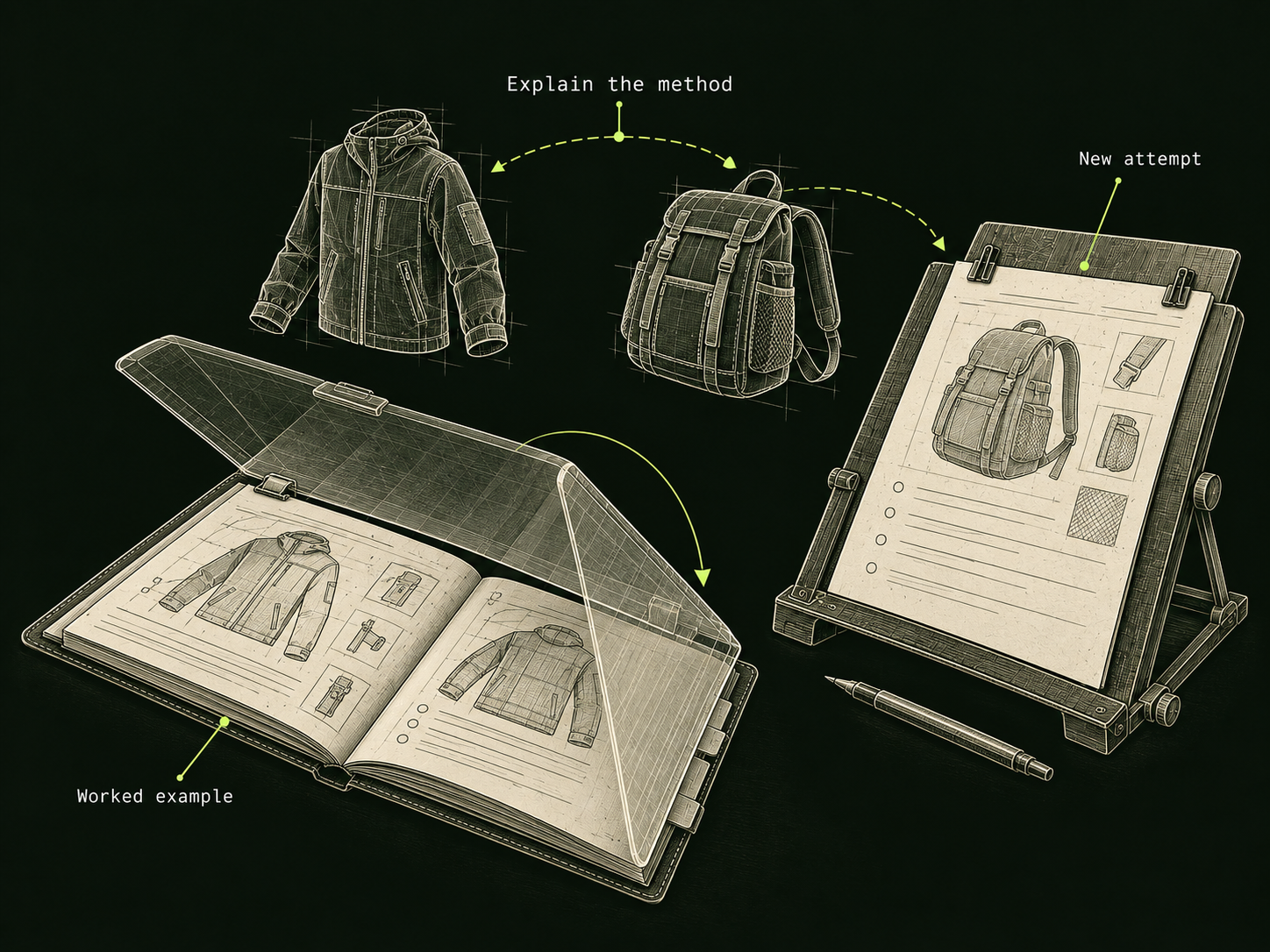
Use the same method when studying a written source
For a chapter or article, identify the passage you are studying and ask for questions that refer to it. Check the answer against the source. Do not treat a fluent explanation as a replacement for the material your course actually requires.
Try a short sequence: explain the idea in your own words, compare with the passage, identify one mismatch and answer a new question. When a term is unclear, ask for a specific example and a non-example. The difference between them often reveals the boundary of the concept.
Keep a small list of mistakes you made and how you corrected them. That becomes a more useful revision aid than an archive of polished generated answers. You finish with evidence of what you can now do, not merely evidence that an assistant can complete the page.
Sources & further reading
Follow the original source to check its date and scope.
- Retrieval practice produces more learning than elaborative studying with concept mapping
Karpicke and Blunt | Science, 2011 | study of learning methods, not a chatbot evaluation.
Make it your next question
Try this prompt
Use this promptHelp me practise a topic I am allowed to study with AI. Ask for my attempt first. Give one hint at a time and wait for my response. After feedback, set a different problem and ask me to explain the method without showing the solution.
Opens chat with this prompt filled in. You choose when to send it.