Start with the data path, not the lock icon
For a hosted chatbot, the message leaves your device so a remote service can process it. The path may include the website operator and a model provider. Connected tools can create additional destinations. You need the service’s current documentation to identify those participants; a chatbot’s generated explanation of its own infrastructure is not enough.
HTTPS protects the connection in transit. It does not by itself tell you who can access stored messages or how long they are retained. Likewise, an incognito browser window is not a promise that a remote service forgets the requests it receives.
Write four questions before sharing a sensitive file: who receives it, why is it needed, how long is it kept and how can access be ended? If the answers are unclear, use a smaller excerpt or a fictional example while you investigate.
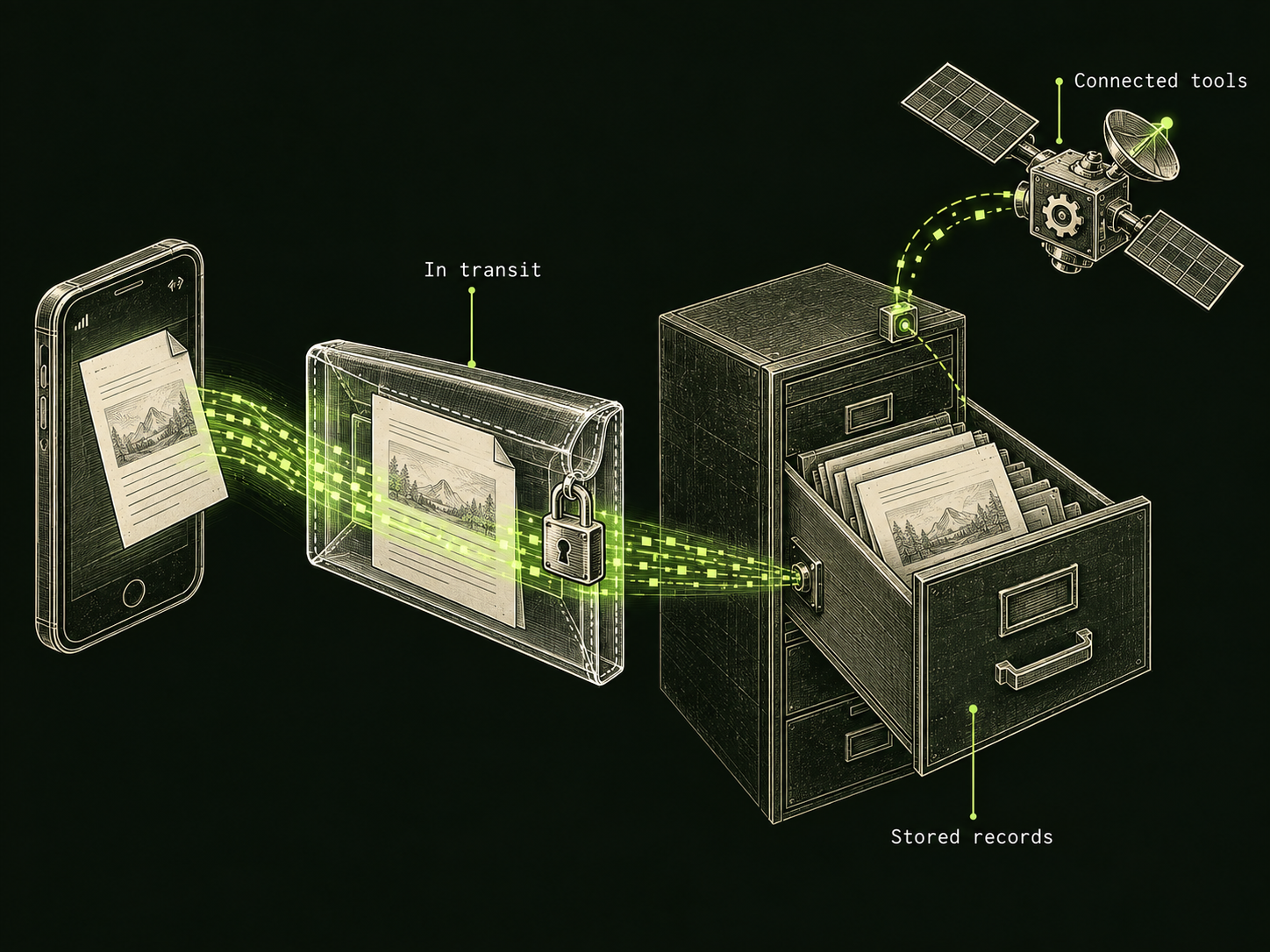
Treat privacy controls as different controls
| Control | Question to ask |
|---|---|
| Transport | Is the connection encrypted? |
| Retention | What records are stored and for how long? |
| Training | Does this service use this account’s content for model improvement? |
| Sharing | Who can open an exported or shared conversation? |
| Connected tools | Which other services receive the request or file? |
Read the current policy and the settings that apply to your account. A statement about training is not automatically a statement about operational logs or retention. A deletion button is not a complete description of every backup and processor.
The UK ICO’s 2025 explanation of AI data protection stresses transparency about personal-data use and rejects the idea that AI models are automatically free of privacy risks. This is a useful reason to ask precise questions; the controls available to you still depend on the service and applicable rules.
A redacted brief that still lets the assistant work
Imagine you want help writing a reply about a delayed appointment. The assistant needs the scheduling problem and the tone, not a customer’s address or a full account history. The following is an invented case.
Task: draft a short apology for a delayed appointment.
Customer: [CUSTOMER_A]
Original appointment: [DAY_A] at [TIME_A]
New options: [OPTION_1] or [OPTION_2]
Cause: a booking error on our side.
Tone: direct and calm. Do not invent compensation.
After reviewing the draft, restore the real appointment details locally. This reduces what you send while keeping the decision useful. It is not a proof of anonymity: a distinctive event or combination of details could still identify someone.
For a code problem, replace credentials with placeholders and share the failing function instead of an entire production configuration. For a document review, select the paragraph needed for the question. The aim is to remove irrelevant exposure without removing the context that changes the answer.
![A folder holds a document with black redaction strips beside a local envelope containing identity and address cards. Lime arrows lead to a brief labelled [CUSTOMER_A], [DAY_A] and [OPTION_1].](/guide-plates-v4/is-ai-chat-private--redacted-brief.webp)
Decide whether this task needs a different environment
Some tasks can be solved with placeholders. Others genuinely require identifiable information or a complete confidential record. In that case, first confirm that the chosen environment is appropriate and that you are permitted to share the material there.
A locally running model changes the processing path, but inspect the whole application. A local interface might still use remote search or another connected service. The word “local” cannot answer questions about each enabled tool.
Keep a short record of what you sent and which service you used when the material matters. That makes later review or deletion requests more concrete. The most useful privacy habit is deciding what the assistant actually needs before the information has already left your device.
Sources & further reading
Follow the original source to check its date and scope.
- Debunking data protection myths about AI
ICO | January 2025 | transparency and personal-data risks in AI.
Make it your next question
Try this prompt
Use this promptHelp me prepare a redacted brief for an AI assistant. Ask for the type of task without requesting sensitive details. Suggest placeholders and identify which context is necessary. Do not claim that replacing names guarantees anonymity.
Opens chat with this prompt filled in. You choose when to send it.