Separate AI use from copying and attribution
Ask three questions: did the writer use AI, did the text reproduce another source, and does the draft properly credit the ideas it relies on? These questions overlap, but none answers the others automatically.
A person can copy a paragraph without using AI. An assistant can produce a draft that needs no quotation attribution for its wording but still depends on an unattributed argument supplied in the prompt. The absence of an identical sentence does not establish originality.
WAME’s recommendations for scholarly manuscripts place responsibility for accuracy and attribution on the human authors, including when chatbots contribute material. Those recommendations concern scholarly publication; the rules for your classroom, publication or workplace need to be checked directly. This guide reviews writing practice rather than offering a legal judgment.
A paraphrase can preserve someone else’s argument
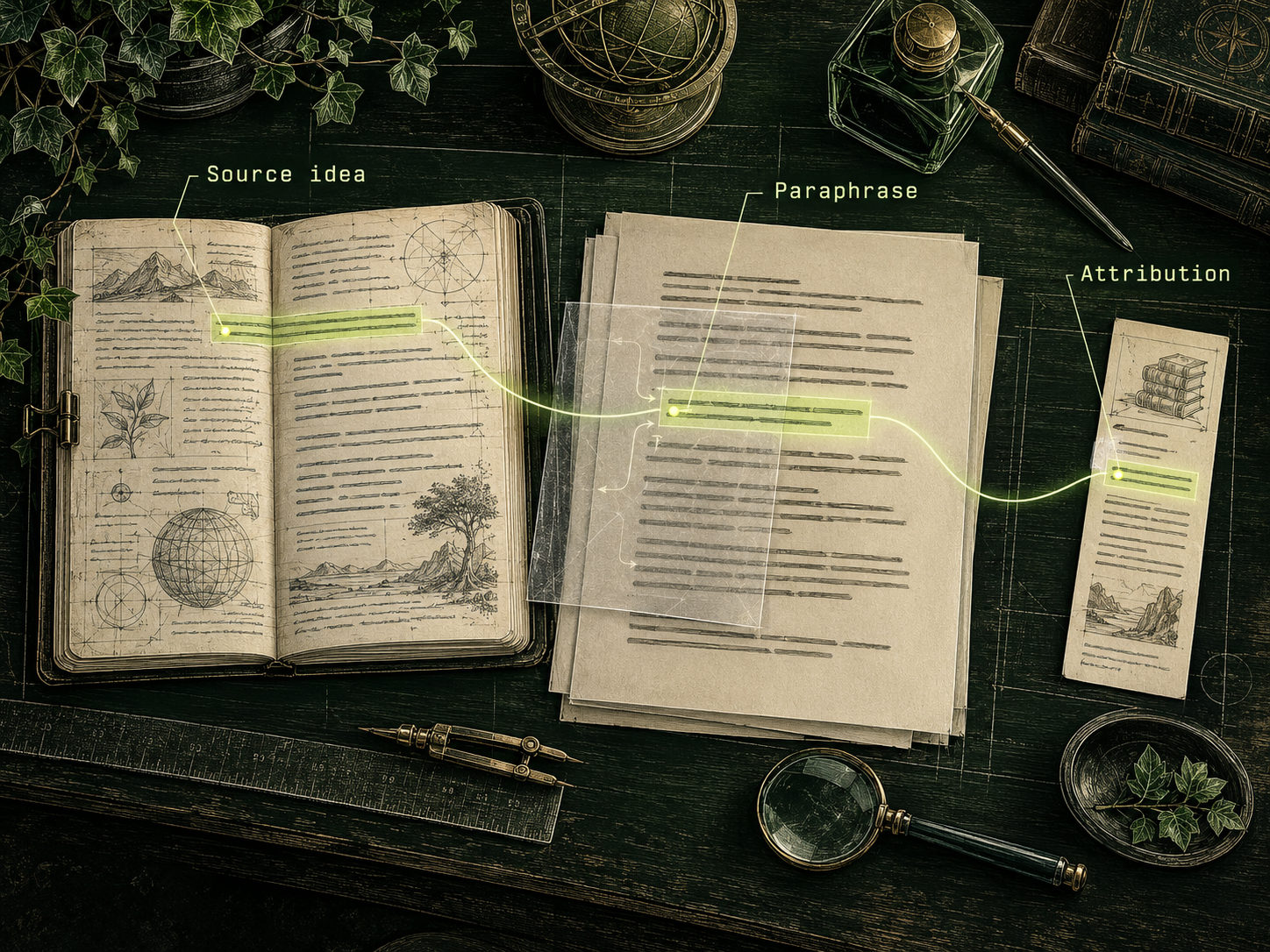
Consider an invented source note: a neighborhood report argues that extending library opening hours would help shift workers, based on interviews with residents who finish work after closing time. A draft changes the phrasing but presents the same recommendation and interview finding without attribution.
Different wording does not turn those interviews into the writer’s own research. The draft should identify the report and accurately describe its evidence. If the writer adds an argument about weekend access, that new argument should be separated from what the report established.
Compare the draft with the original note. Which observations came from the source? Which interpretation belongs to the writer? Which sentences imply that the writer conducted the interviews? This review follows the ownership of claims rather than hunting only for matching phrases.
What different writing checks can actually tell you
| Check | What it examines | What still needs review |
|---|---|---|
| Text similarity | Overlap with material in its comparison set. | Whether quotations and ideas are attributed correctly. |
| AI detection | Patterns a tool associates with generated writing. | The actual writing process and the tool’s error limits. |
| Citation review | Whether the cited source supports the claim. | Missing sources and misleading paraphrases. |
| Editorial review | Clarity, evidence and the writer’s contribution. | Whether the applicable AI-use policy was followed. |
A low similarity score does not prove that all ideas are credited. A high score can include properly quoted passages. A detector result does not establish the source of an argument or the history of a draft.
Use drafts, notes and revision history to document the process. If someone asks how the work developed, those records can address the actual steps far more directly than rerunning the final paragraph through several unrelated scoring sites.
Keep sources attached while drafting with AI
Prepare source notes with publication details, relevant passages and your reason for using each source. When asking for help, distinguish quoted source material from your own outline. Tell the assistant which claims must remain tied to which evidence.
Review any new citation before accepting it. If the assistant introduces an argument you cannot trace, decide whether to find supporting evidence, label it as a proposal or remove it. A reference that merely looks plausible should not enter the bibliography.
Write your own explanation of the contribution: what question you asked, what evidence you selected and how your conclusion follows. Then use AI for a bounded task such as testing the outline or clarifying a sentence. Preserve meaningful revisions so polishing does not erase the connection between the argument and your work.
Check the actual rule before submitting the draft
Read the policy that governs the work. It may permit editing assistance while restricting generated analysis, require a disclosure or forbid particular uses. Follow that rule instead of assuming a generic internet definition applies.
Before submission, compare key paraphrases with their sources, verify quotations and citations, and remove claims you cannot support. Disclose assistance where required, using an accurate description of what the tool did. Do not claim that no AI was used merely because you rewrote its suggestions afterward.
Originality is a property of the work and its contribution, not a badge produced by a detector. A defensible draft lets a reader follow the evidence, understand the writer’s reasoning and see the relevant attribution. That remains the standard whether the first version came from a keyboard, a conversation or a mixture of both.
Sources & further reading
Follow the original source to check its date and scope.
- WAME recommendations on chatbots and scholarly manuscripts
WAME | human authors remain responsible for accuracy, source attribution and the material they submit.
Make it your next question
Try this prompt
Use this promptHelp me review a draft and its source notes for attribution. Distinguish direct quotations from paraphrases and my own claims. Flag passages needing comparison with the original source. Do not promise a plagiarism-free result or treat a detector score as proof.
Opens chat with this prompt filled in. You choose when to send it.