Does a detector percentage prove AI wrote the text?
No. A score is the output of a particular detector applied to a particular input. It is not an eyewitness account of the writing process. Before interpreting a number, find out whether it describes a confidence estimate, a proportion of sentences flagged or something else. Those are different measurements.
Liang and colleagues studied several detectors in 2023 and found that non-native English writing could be misclassified as AI-generated. That is evidence of a limitation in the tested systems, not a measurement of every detector available today. It is enough to challenge the idea that a detector result alone establishes authorship.
If someone questions your own work, preserve drafts and revision history. Explain how you developed the argument and where its evidence came from. Do not assume another website’s percentage will settle the disagreement. The process record addresses a different question from the detector’s pattern estimate.
What an AI humanizer is actually offering
A tool marketed as an AI humanizer typically offers to rewrite text. The name does not establish a standard editing method or a guarantee about another company’s detector. A smoother version may still contain the same unsupported claim. An awkward version may merely replace words while making the argument harder to follow.
Consider a sales page promising “100% human.” Ask which detector, version, language and type of text were tested. Was the full result disclosed? Was the paragraph checked after a later update? A screenshot can show one observed result without supporting a universal promise.
There is also a question the sales pitch tends to omit: are you allowed to use rewriting assistance for this task? Follow the actual requirements for the publication, client or assignment. Editing should improve the work and preserve an honest account of how it was produced.
Edit a claim instead of disguising its origin
“Our revolutionary solution effortlessly transforms your productivity and guarantees better outcomes.”
Invented draft used for this editing example
The problem is visible without a detector. The sentence names no activity, supplies no evidence for the guarantee and does not explain what the reader receives. Replacing “revolutionary” with “groundbreaking” leaves those problems intact.
A more useful version for a fictional scheduling service would be: “Build a weekly rota from staff availability, then review conflicts before publishing it.” This is an editorial example, not a verified product claim. It replaces an impressive mood with a task and a review step.
To finish the edit, ask the writer whether the service really performs that task. If not, the new sentence also needs changing. Better writing cannot rescue an inaccurate description. The writer still has to supply the facts.
Use a review sheet with separate decisions
| Question | Evidence to look for | Useful action |
|---|---|---|
| Is the claim specific? | A named task and result. | Replace empty praise with the actual behavior. |
| Is the claim supported? | A source or a documented observation. | Verify it or remove the assertion. |
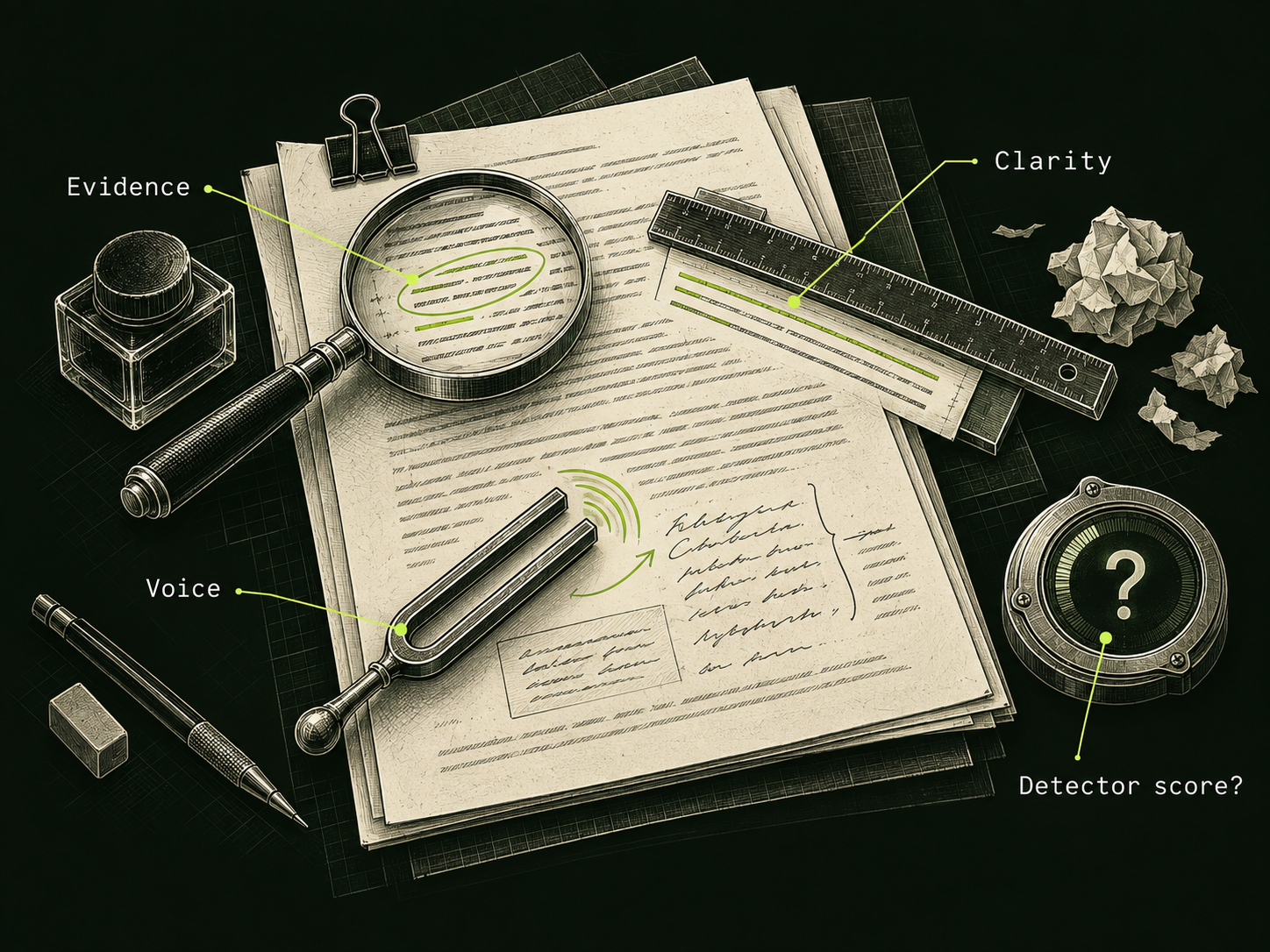
| Does the voice fit? | Language the intended writer would use. | Revise phrasing while preserving meaning. |
| Is the process honest? | The applicable rules and a revision record. | Disclose assistance when required. |
Keep these decisions independent. A personal anecdote can sound natural and still be invented. A formal paragraph can be accurate and genuinely written by a person. Treating “sounds human” as the only target rewards the wrong thing.
Read the final version aloud and compare it with the original argument. Check that the edit did not remove an important qualification or insert a new promise. Those checks are actionable even when two detectors disagree.
What to do when a detector flags your writing
Start with the exact concern. If a client says the draft feels generic, request a line-level example and edit that problem. If an institution raises an authorship question, ask how the review process handles evidence beyond a detector score. Keep your working notes rather than repeatedly replacing the text to chase a number.
For your own writing, use AI as an editor that explains changes. Supply facts you can stand behind and tell it which sentences reflect your personal experience. Reject invented examples that the model attributes to you.
A useful finished draft has a clear point, accurate claims and a voice that suits its reader. None of those qualities is guaranteed by a green detector badge. Evaluate the text you are publishing, not a label another tool assigns to it.
Sources & further reading
Follow the original source to check its date and scope.
- GPT detectors are biased against non-native English writers
Liang et al. | revised July 2023 | limitations measured in the tested detectors.
Make it your next question
Try this prompt
Use this promptReview my draft for vague claims and an unnatural voice. Ask for the intended reader first. Keep my meaning and flag unsupported claims. Explain each edit without promising to change an AI detector score.
Opens chat with this prompt filled in. You choose when to send it.