What a context window contains
The context window is the amount of tokenized information a model can work with for a response, subject to the system’s particular limits. It can include instructions, conversation messages, tool results and supplied material. Output capacity and other constraints also depend on the model and application.
A token is a unit used by the model’s text representation, not a fixed number of words or characters. Code, different languages and formatting can have different token counts. Do not treat an advertised token limit as an exact page count for your own documents.
The visible chat history is an interface record. The application may select, summarize or omit parts when preparing the next request. A long sidebar transcript therefore does not establish that every earlier sentence remains in the active context.
Why a bigger window does not guarantee better recall
Capacity answers how much can fit; it does not establish how reliably every detail will be used. A large input can contain conflicting decisions, irrelevant excerpts and repeated drafts that make the important requirement harder to locate.
Anthropic’s context-engineering guidance recommends treating context as a finite resource and curating relevant information. It discusses summarization and structured notes for longer tasks. That engineering advice supports a workflow choice, not a promise that a particular summary guarantees recall.
First inspect the input. If one message says the event starts at 18:00 and a later correction says 19:00, label the accepted time explicitly. Adding both messages again without identifying the correction creates more text without resolving the conflict.
A project brief that survives the next conversation
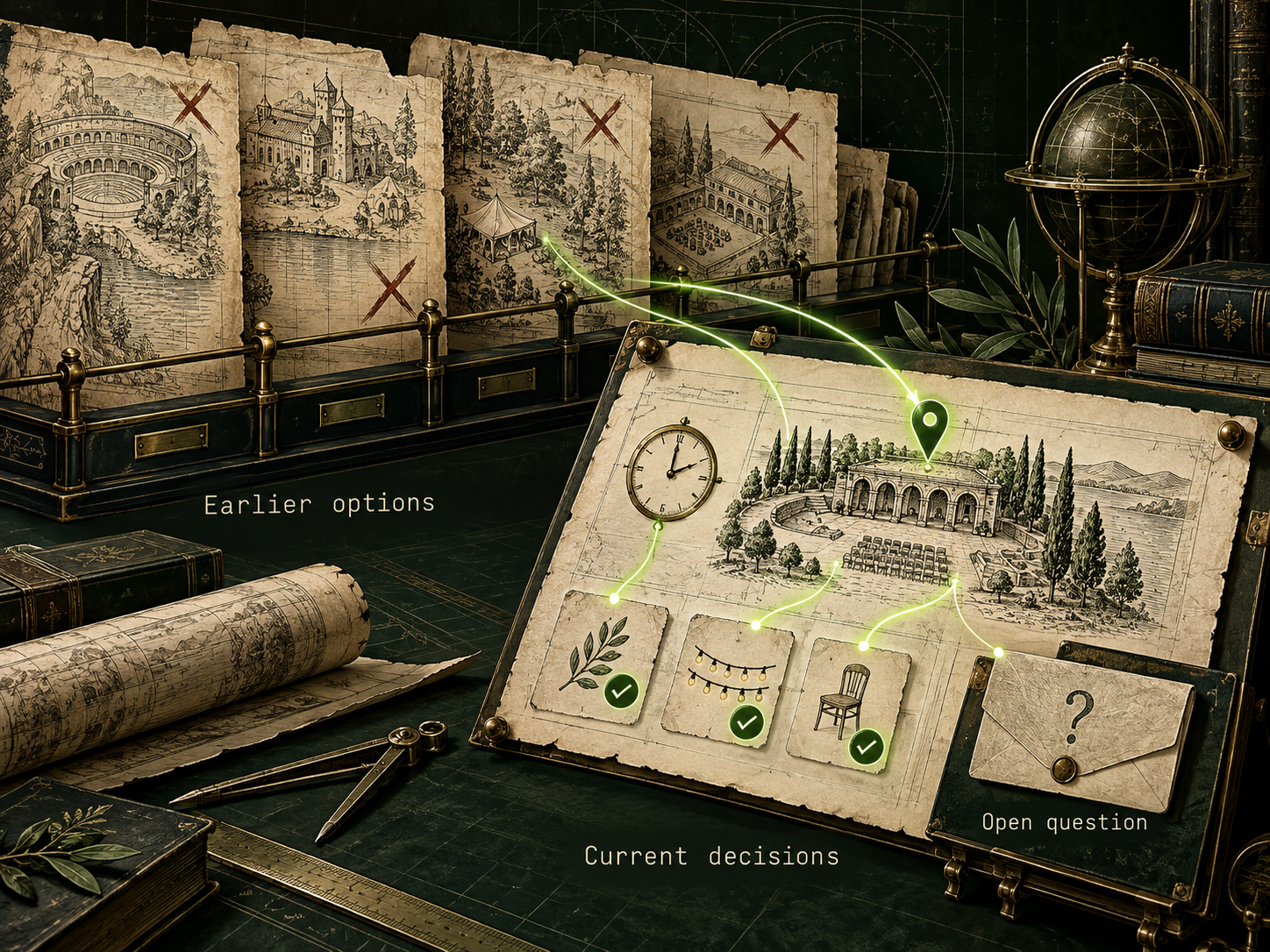
Imagine an original planning example: a small exhibition has changed venues twice and rejected several poster concepts. The useful handoff is not a chronological transcript of every brainstorm. It is the current state, with the accepted decisions and the open questions.
Project: a fictional neighborhood photography exhibition.
Current venue: the community hall. Earlier studio proposal rejected.
Opening time: 19:00. Earlier 18:00 time superseded.
Poster direction: monochrome photograph with one lime accent.
Accepted constraint: do not print a ticket price until confirmed.
Open question: whether admission is free or requires a donation.
Next task: draft poster copy using only these current decisions.
Review the handoff before reusing it. A summary can omit a critical constraint or accidentally turn an option into a decision. Keep the original notes accessible for resolving uncertainty rather than treating the compact version as infallible.
Context, saved memory and retrieval are different mechanisms
| Mechanism | What it supplies | What to verify |
|---|---|---|
| Active context | Information included in this request. | Whether the current requirement is actually present. |
| Conversation summary | A condensed account of earlier material. | Whether it preserves decisions and uncertainty accurately. |
| Saved memory or profile | Information stored for later personalization. | What is saved and when the product uses it. |
| Document retrieval | Selected passages from an external collection. | Whether the relevant permitted passage was found. |
Do not infer the mechanism from a familiar-sounding answer. A chatbot can repeat a detail because it is still in context, because it was retrieved or because it generated a plausible guess. Check the actual feature and the evidence available in your application.
For a document-based project, a brief plus references to the relevant files may be more useful than pasting the whole collection every time. The files must still be accessible through a permitted workflow.
Keep continuity with a small update routine
At a useful milestone, update the project record: current goal, accepted decisions, relevant files and unresolved questions. Remove discarded alternatives from the active brief while preserving them in the original notes if needed.
At the start of the next task, provide the current brief and the specific material required for that step. Ask the assistant to flag conflicts before proceeding. If an answer ignores a constraint, check whether the constraint was present and unambiguous before simply requesting a larger response.
This method does not require a magic reset phrase or a promise of unlimited memory. It makes the working state explicit and easier to verify. Longer context can be valuable, but continuity improves when the important information is organized around the task you are doing now.
Sources & further reading
Follow the original source to check its date and scope.
- Effective context engineering for AI agents
Anthropic | curate finite context and preserve task state through structured notes and careful summaries.
Make it your next question
Try this prompt
Use this promptHelp me create a compact project handoff from notes I provide. Preserve accepted decisions and unresolved questions. Separate current requirements from discarded alternatives. Ask for missing facts rather than inventing them.
Opens chat with this prompt filled in. You choose when to send it.