Decide what makes the character recognizable
List a small set of stable visual traits: silhouette, facial proportions, hair shape, clothing structure and a distinctive object or mark. Avoid treating every tiny detail as equally important. A recognizable design should survive a change in lighting or viewpoint.
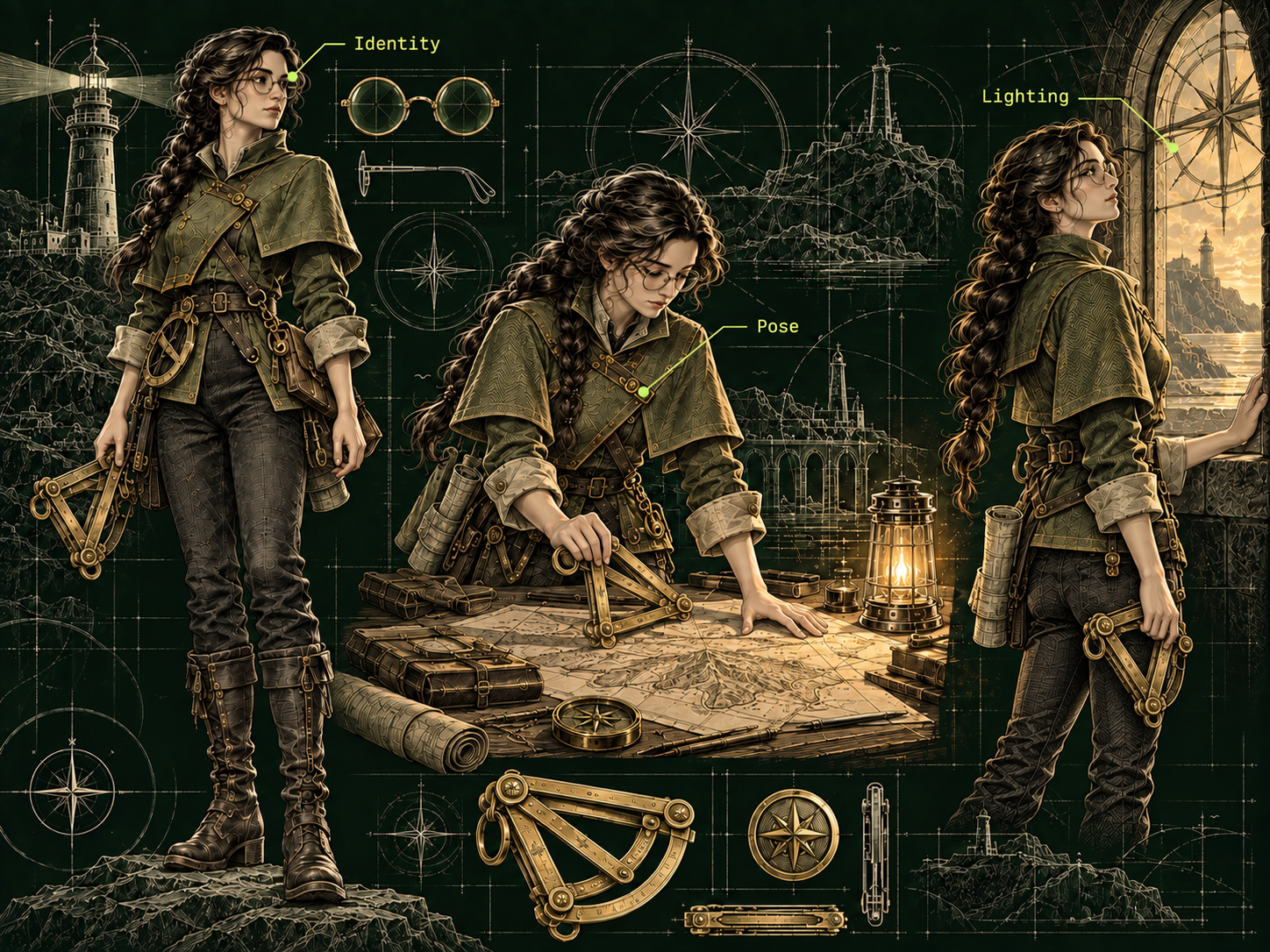
For an original fictional example, create Nera, a lighthouse cartographer. Her stable traits are a broad dark braid, a short olive coat with an asymmetric front closure, round glasses and a folded brass measuring instrument. Her pose, expression and location can change.
Separate those traits from narrative facts. “She is curious” may guide expression, but it does not specify a repeatable visual feature. “Round glasses with thin brass rims” gives both the generator and the reviewer something concrete to inspect.
Make a reference sheet before requesting a series
A reference sheet establishes the approved design before new scenes multiply. It can show a neutral front view, a side view and the important clothing or prop details. Keep the views consistent so the reference itself does not introduce contradictions.
Use your own permitted material. If you have several candidate images, choose one approved identity rather than feeding every variation back into the next request. Otherwise the reference set can ask for incompatible features.
Check what your image tool means by a reference. Adobe Firefly documents composition and style references as different controls. A reference that guides arrangement or aesthetic does not automatically guarantee identity preservation. Use the feature actually available in your chosen tool and evaluate its result rather than assuming all reference inputs work the same way.
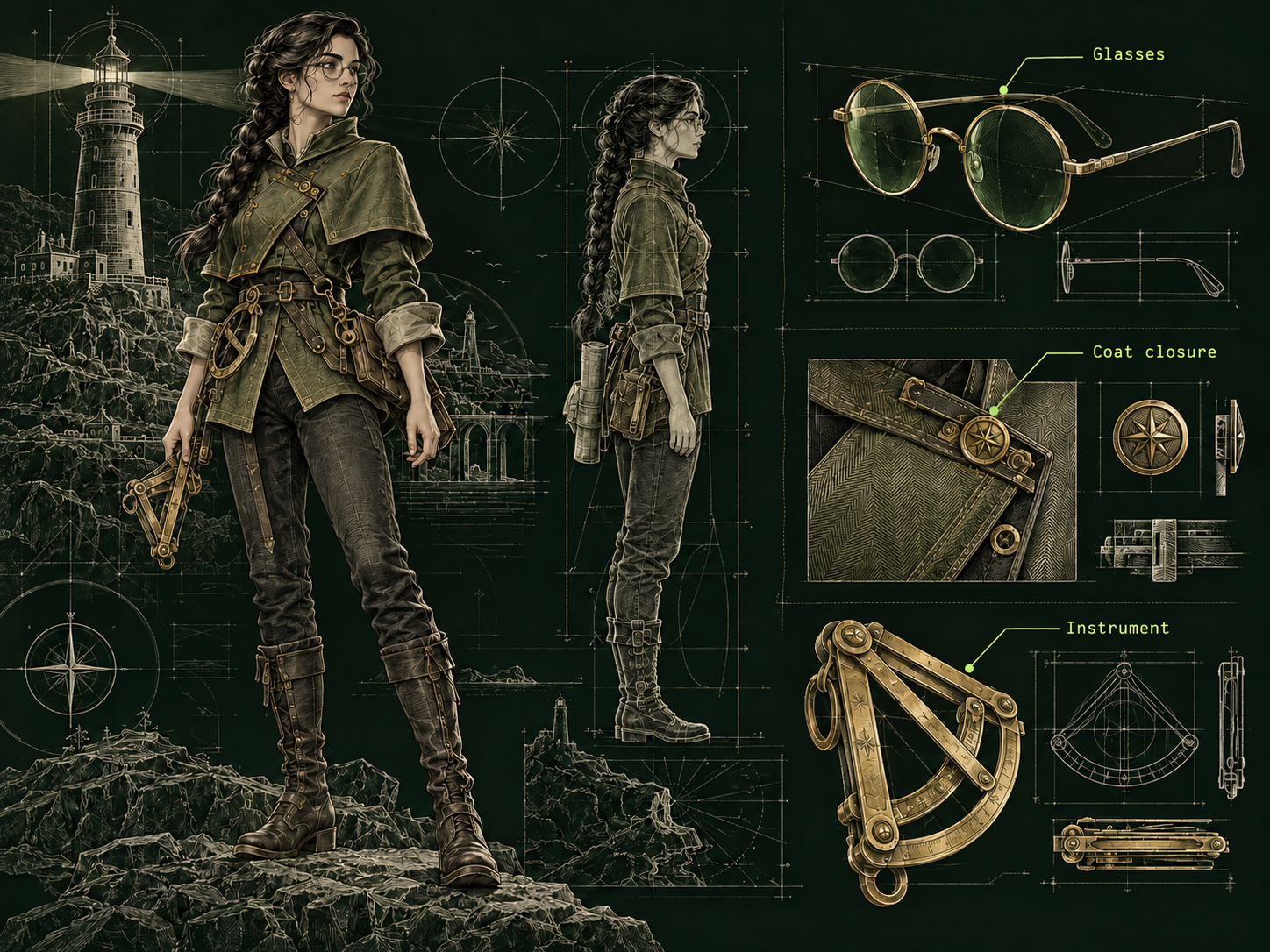
Separate identity, style and the scene in the brief
| Layer | Keep stable | Allow to change |
|---|---|---|
| Identity | Braid, glasses, coat closure and instrument design. | Expression and natural posture. |
| Visual treatment | Approved illustration method and palette. | Light direction suited to the scene. |
| Scene | The character’s scale and role in the story. | Location, camera angle and action. |
Original character: Nera, the lighthouse cartographer.
Use the approved character reference for identity.
Preserve the broad braid, round glasses and asymmetric olive coat.
Scene: she studies a paper map at the lantern room window.
Change the pose and lighting for this scene.
Do not redesign the coat or replace the measuring instrument.
The layers let you name a failure accurately. A changed coat is an identity problem. A different rendering method is a style problem. A cropped-out map is a composition problem. A vague request to make everything “more consistent” cannot distinguish them.
Review the series as a set rather than one image at a time
Place the approved reference beside the scene candidates. Compare the stable traits before judging mood or dramatic effect. A beautiful frame can still be the wrong character for the series.
For Nera, inspect the glasses, closure and prop separately. If the coat closes on the opposite side, identify that specific mismatch. If the instrument became a telescope, request a correction to the prop without unnecessarily rebuilding the face.
Track accepted versions and rejected changes. Reusing a later scene with an accidental redesign as the next reference can spread the mismatch through the series. Keep the master reference stable until you intentionally approve a design change.
This is a continuity method, not a claim that any particular generator will obey every constraint. A tool may require manual editing or a different workflow for details it cannot preserve reliably.
Know when prompting has reached its limit
Text prompts are one control among several. Depending on the tool, reference inputs, localized editing or manual compositing may be more effective for preserving a specific feature. Check the available controls and their actual output.
Do not promise perfect identity from a seed, a character name or a style label alone. Treat those settings as part of the workflow you can test, with results that may change across models and versions.
For a finished series, define an acceptance standard: which identity traits must match, what variation is acceptable and who signs off on the design. DarkGPT can help write and review the brief; it does not provide an image-generation feature. Use your chosen image tool for production, then keep the approved design record available for every scene that follows.
Sources & further reading
Follow the original source to check its date and scope.
- Match image composition to a reference
Adobe | composition controls concern arrangement and structure.
- Set styles for image generation
Adobe | style references guide aesthetic treatment; inspect the actual result for identity consistency.
Make it your next question
Try this prompt
Use this promptHelp me prepare a visual continuity brief for an original fictional character. Separate identity from style and scene composition. Define a reference sheet and a review checklist. Return written briefs only; do not claim to generate images.
Opens chat with this prompt filled in. You choose when to send it.