Start with what the image is being used to claim
Write the claim in a testable form: who supposedly did what, where and when? “This clip looks suspicious” is an observation. “This person announced a new policy yesterday” is a claim requiring evidence about the event and the recording.
The claim can be false even when the media is authentic. An old clip may be attached to a new date. A real photograph may be cropped to hide context. Conversely, synthetic media may be clearly labeled and make no deceptive factual claim.
Decide what needs verification before examining tiny visual details. If the post claims a public announcement, the original announcement record matters. If it claims a particular location, independent location evidence matters. Authenticity and the truth of the caption are related but separate questions.
Trace the earliest source you can actually verify
Look for the original uploader, a longer recording or the publication that first distributed the image. Search distinctive wording from the caption and use reverse image search where appropriate. Record what you find and what remains unknown.
A repost from a familiar account is not the same as an original source. Ask whether that account recorded the event, received a file from someone else or simply repeated another post. Repetition can create the appearance of corroboration without adding independent evidence.
Preserve the version you are checking, including its caption and source URL. Avoid repeatedly re-encoding it during review, since changes can remove metadata and introduce artifacts. Compare the surrounding material in the original publication when available rather than treating a cropped screenshot as the whole record.
What visual clues, metadata and detectors can tell you
| Signal | Useful for | Important limit |
|---|---|---|
| Visual inconsistencies | Identifying details worth investigating. | Real images can contain distortion and compression artifacts. |
| File metadata | Finding recorded technical or origin information. | Metadata may be absent, modified or stripped. |
| Provenance credentials | Inspecting a supported signed record of origin or edits. | A missing credential does not establish fakery. |
| Synthetic-content detector | Adding a tool-specific assessment. | Its result depends on the tested media and error limits. |
| Independent original record | Checking the event and its context. | Confirm it genuinely covers the same claim. |
NIST’s report on synthetic-content transparency examines provenance, labeling and detection as distinct technical approaches. No single approach answers every authenticity question. Treat a detector’s result as one signal rather than a final verdict about the depicted event.
A dramatic clip with the wrong date
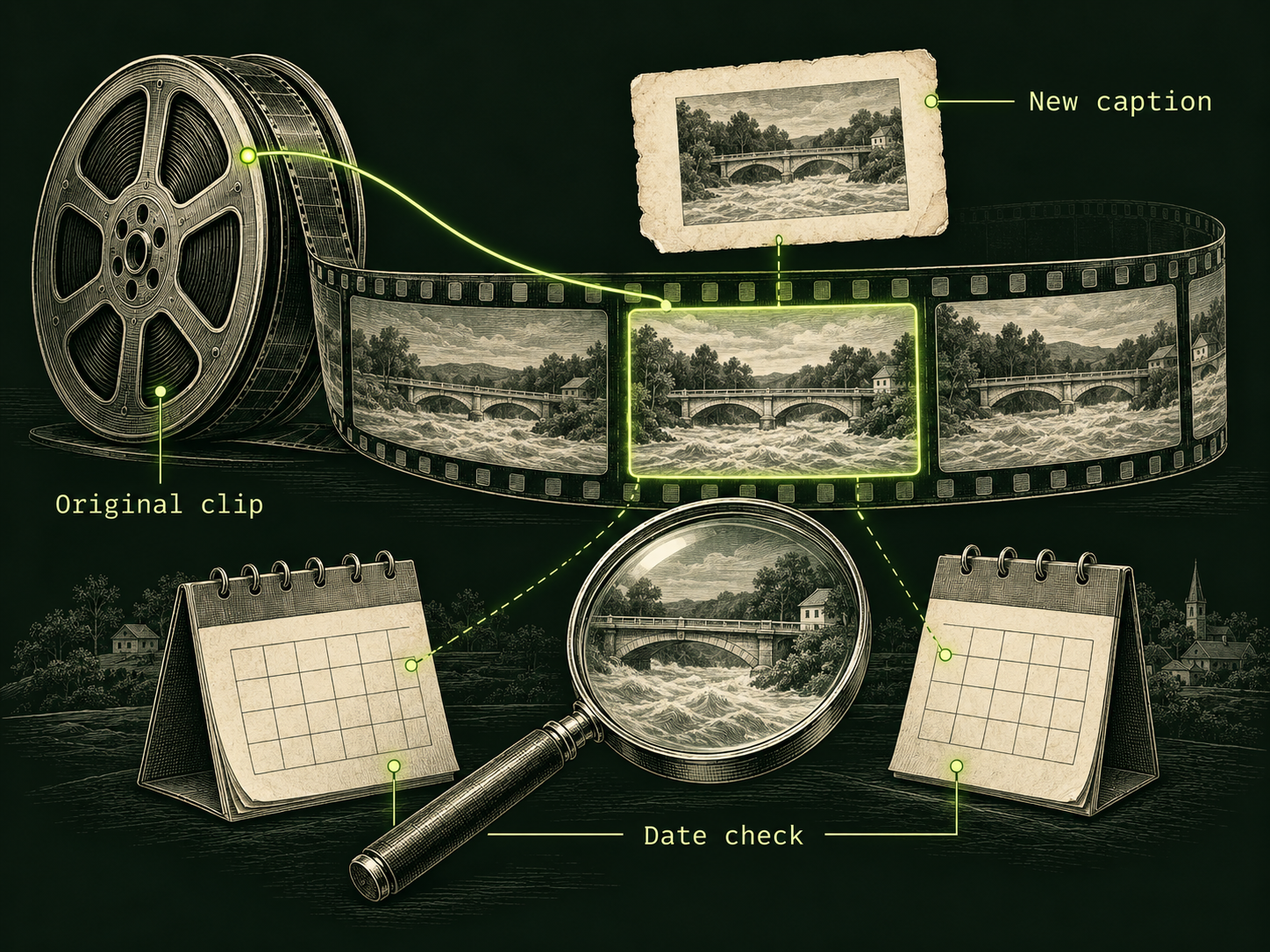
Imagine a fictional viral clip showing a bridge under floodwater. The caption says the bridge collapsed this morning. A reverse search finds a longer version published two years earlier, and that version shows the bridge still standing after the water recedes.
The crucial discovery concerns context, not fingers or shadows. Even if the clip is authentic, it does not establish today’s collapse. Check any current official report independently before repeating the claim.
Now imagine that no original can be found. That absence does not prove the clip was generated. Your conclusion should remain narrower: the source and date could not be verified. Save the uncertainty rather than upgrading it into a confident accusation against an uploader or the person shown.
Share a conclusion that matches the evidence
A useful verification note separates established facts, unresolved questions and the check that would resolve them. “The same clip appeared in an earlier publication” is a concrete finding. “This is obviously AI” is a broader claim that needs its own support.
For an impersonation or scam, verify the underlying request through an independently known channel. Do not rely on the suspicious clip’s contact details. Our voice scam guide explains that separate confirmation step.
Keep your language proportional to the evidence, especially when a real person is involved. You can pause sharing while a claim remains unresolved. The goal is not to win a visual guessing game; it is to stop unsupported media claims from becoming facts in your own decisions.
Sources & further reading
Follow the original source to check its date and scope.
- Reducing Risks Posed by Synthetic Content
NIST | provenance, labeling and detection offer different evidence and limitations.
Make it your next question
Try this prompt
Use this promptHelp me plan verification of a suspicious public image or clip. Separate visible observations from claims needing external evidence. Suggest source and context checks. Do not identify a person from an image or declare authenticity from appearance alone.
Opens chat with this prompt filled in. You choose when to send it.